

The Ultimate Guide to Termite Treatment: Protect Your Home and Structural Investment
Termites, often called "white ants" in India, are among the most destructive pests on earth. Unlike cockroaches or rodents that make their presence obvious, termites are silent destroyers. They chew through wooden furniture, door frames, modular kitchens, drywall, and structural timber from the inside out, often leaving no visible damage until the structure is hollowed out and on the verge of collapse.
For homeowners and property managers in the Delhi National Capital Region (NCR)—including Noida, Gurgaon, Ghaziabad, Faridabad, and Greater Noida—termites are not just a possibility; they are a persistent threat. The combination of high clay soil moisture, subterranean channels, and hot, humid monsoon seasons creates the perfect environment for subterranean termites to colonize and destroy residential and commercial buildings.
This master-level guide provides everything you need to know about termite behavior, identifying infestations early, pre-construction and post-construction chemical barriers, DIY limitations, professional treatment processes, and seasonal maintenance checklists to keep your home safe.
Understanding Termites: Who and What Are They?
Before diving into treatment strategies, it is crucial to understand the enemy. In India, the primary culprits behind property damage are subterranean termites. They live in massive underground colonies, sometimes containing millions of individuals, and tunnel upward through the soil to seek out cellulose (the primary component of wood and paper).
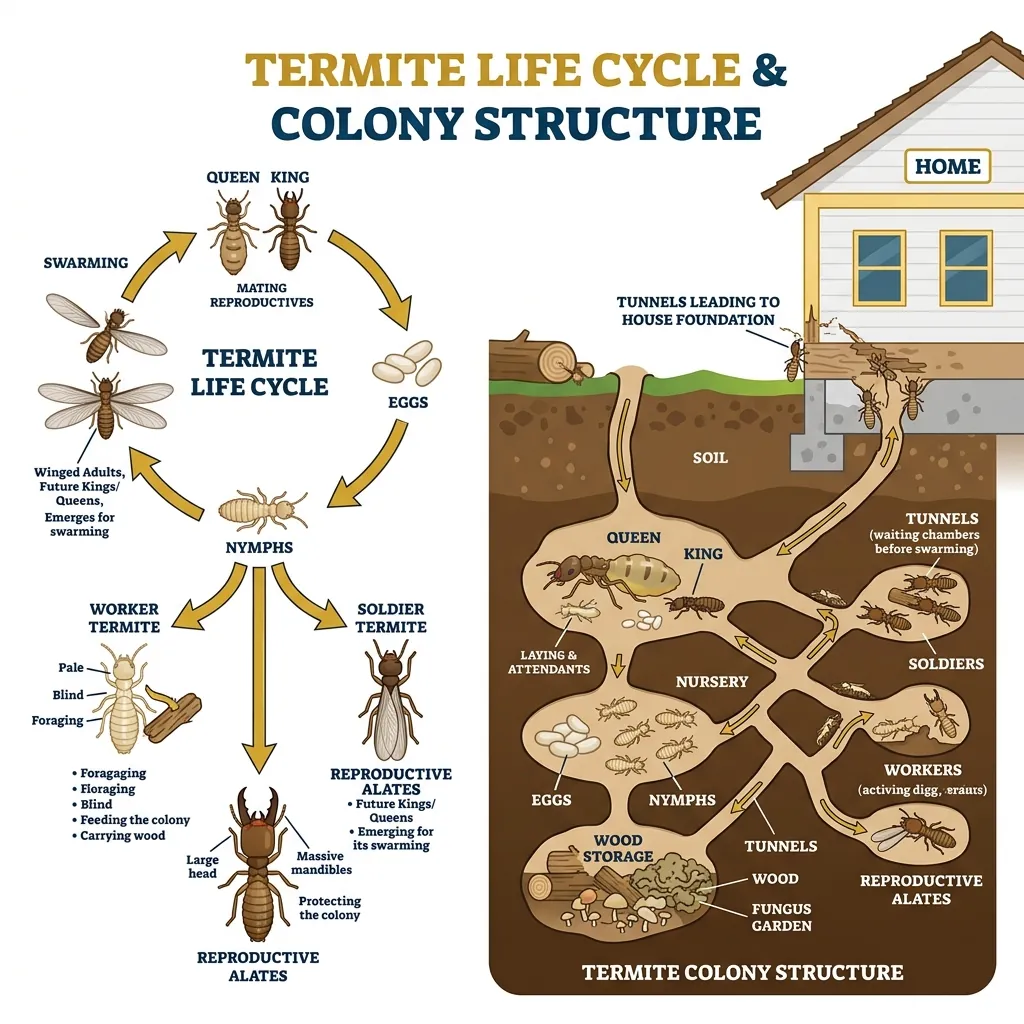
A typical termite colony consists of a complex caste system, each fulfilling a specific role to ensure the colony’s growth and survival:
1. The Queen and King
The founders of the colony. The queen can live for up to 25 to 30 years and is capable of laying thousands of eggs per day. Removing individual worker termites does nothing to stop the infestation if the queen remains alive and producing.
2. Workers
These are soft-bodied, blind, wingless, and cream-colored termites. They comprise the majority of the colony and are responsible for foraging, feeding the colony, maintaining tunnels, and grooming. They chew through wood and transport cellulose back to feed the nest.
3. Soldiers
Armed with large mandibles and yellow-brown heads, soldier termites protect the colony against predators (chiefly ants). They are aggressive defenders but cannot feed themselves; they rely on worker termites to feed them via regurgitated food.
4. Reproductive Alates (Swarmers)
These are winged termites that emerge from established colonies in spring or early monsoon seasons to mate and establish new colonies. Seeing winged swarmers indoors is a definitive sign of a mature, active colony nearby.
!Termite Lifecycle and Colony Structure
Early Warning Signs of a Termite Infestation
Because termites feed inside wood and underground, they can go unnoticed for years. Catching them early can save you lakhs of rupees in repairs. Look out for these critical signs:
1. Mud Tubes on Walls and Plinth Levels
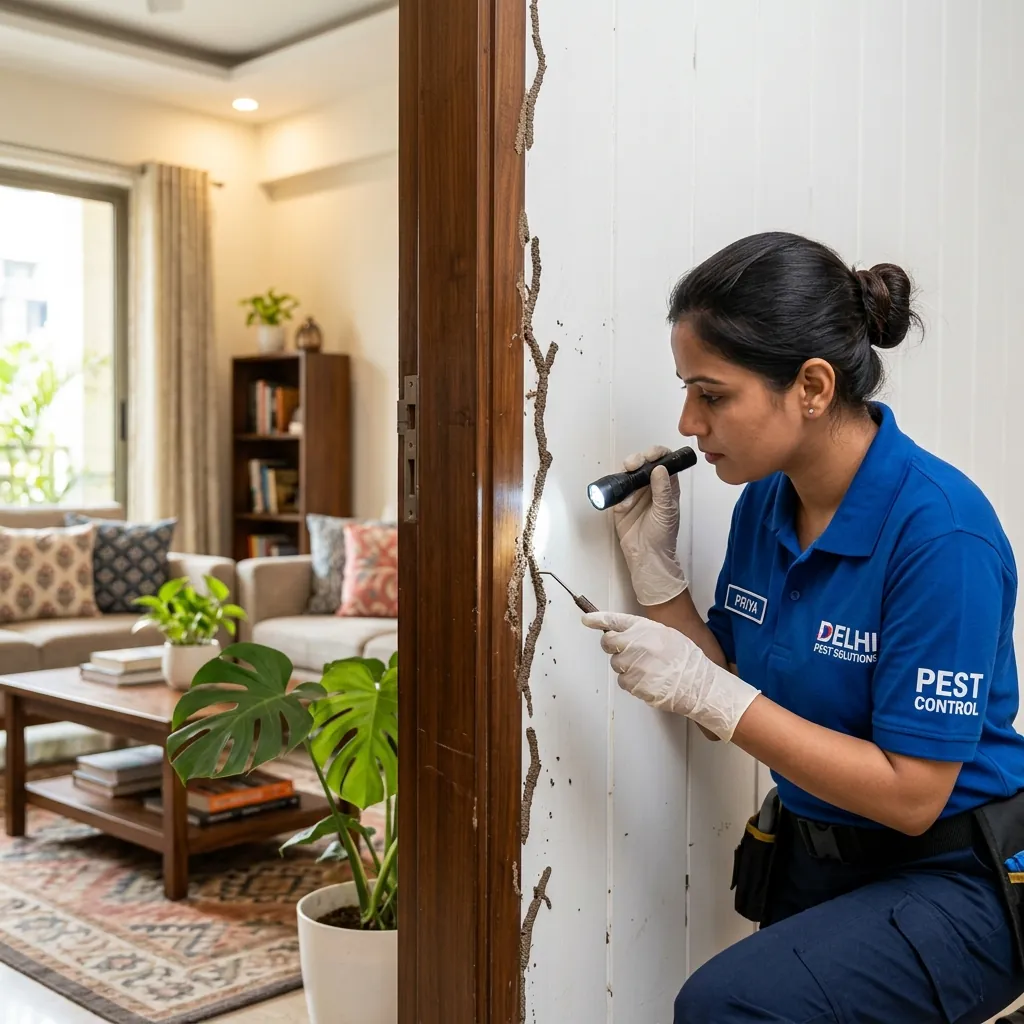
Subterranean termites require constant moisture to survive. They build pencil-sized mud tubes made of soil, wood particles, and saliva to travel safely between their underground nests and the wooden components of your house without drying out. These are commonly found climbing up external walls, foundation slabs, or inside electrical shafts.
2. Hollow-Sounding Wooden Structures
If you tap a wooden door frame, window sill, or cupboard panel and it sounds dull, hollow, or paper-thin, termites have likely eaten the interior core. Sometimes, the outer layer of paint or veneer remains perfectly intact, hiding the destruction underneath.
3. Discarded Wings Near Windows and Light Sources
Winged swarmers are attracted to light. During their mating season, they fly out, shed their wings, and crawl to find a nesting site. Finding piles of identical, small translucent wings on window sills, floors, or light fixtures indicates a termite colony has established itself inside or right next to your home.
4. Hard-to-Open Doors and Windows
As termites consume wood and build moisture-retaining mud structures within frames, the wood swells. This makes doors and windows tight, stiff, and difficult to open or close, a symptom often mistaken for simple monsoon humidity swelling.
5. Termite Frass (Droppings)
Drywood termites (less common than subterranean but still found in Delhi NCR) eject tiny, sand-like fecal pellets called frass from small holes in the wood they occupy. If you notice small mounds of light-brown or black dust beneath wooden items, inspect immediately.
The Heavy Cost of Delay: Health Hazards and Structural Damage
Termites do not pose a direct bite threat to humans, but their presence indirectly compromises your household environment and financial stability:
- Severe Structural Damage: Termites can hollow out wooden ceiling rafters, wall studs, and subfloors. If left unchecked, this compromises the structural integrity of your home, risking sudden collapses that can injure family members.
- Allergies and Asthma: As termites chew through drywall and wood, they spread dust, mold spores, and airborne particulates. The high humidity they generate in their mud tubes fosters toxic mold growth, which can trigger severe asthma attacks, chronic coughing, skin rashes, and respiratory issues in children and sensitive family members.
- Electrical Fire Hazards: Subterranean termites searching for food will chew through non-wood materials including soft plastics, rubber, and plaster. If they chew through electrical insulation inside conduits, it can cause short circuits, power outages, and sudden electrical fires.
- Rapid Devaluation of Property: A home with active or history of untreated termite damage is incredibly difficult to sell. Home buyers and inspectors instantly identify termite mud tubes and hollow door frames, forcing property values down by 20% to 30%.
- Massive Repair Bills: Repairing structural wood, replacing modular kitchens, and fixing damaged drywall can cost anywhere from ₹30,000 to over ₹2,50,000. Investing in early professional treatment is a fraction of the cost of rebuilding.
Why DIY Termite Treatment Methods Fail
Many homeowners attempt to resolve termite problems using DIY solutions like kerosene injections, boric acid sprays, salt water, or off-the-shelf aerosol sprays. While these might kill a few hundred termites on contact, they do not resolve the problem:
1. Failure to Target the Queen and Colony
Termite colonies live deep in the soil, sometimes several feet below the concrete foundation of your home. Spraying topical chemicals on a visible mud tube only kills the foraging workers on that specific wall. The queen remains safe underground, generating new workers to replace them. The infestation will reappear in a different spot within weeks.
2. Standard Chemicals Repel Instead of Eliminate
Most consumer-grade sprays are highly repellent. When applied to termites, they detect the chemical and retreat back to their underground nest. They then bypass the treated area and dig new tunnels to attack other parts of your home, spreading the damage wider.
3. Lack of Specialized Equipment
Professional termite control requires heavy-duty rotary hammer drills, sub-slab injectors, high-capacity soil treatment pumps, and personal protective equipment. Standard household tools cannot inject termiticides deep into the concrete-to-soil interface where termites enter.
4. Chemical Safety Risks
Applying professional termiticides requires precise dilution and application knowledge. Incorrectly handling chemicals poses severe risks of poisoning family members, contaminating drinking water lines, or harming household pets. Professionals use green-label, low-toxicity chemicals applied under strict safety guidelines.
The TrustXcare Professional Termite Treatment Protocol
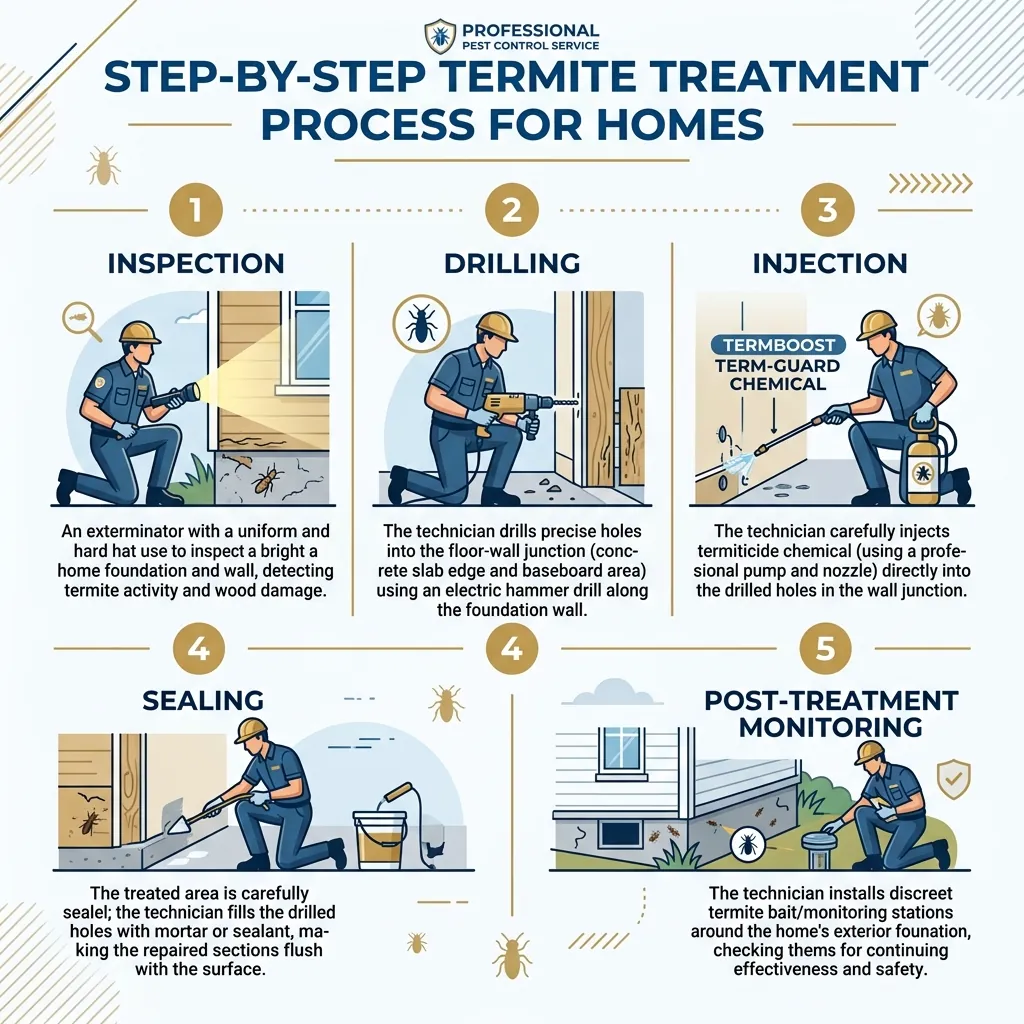
At TrustXcare, we implement a highly systematic, multi-phase treatment protocol based on Integrated Pest Management (IPM) guidelines. We utilize non-repellent termiticides that termites cannot detect. Foraging workers travel through the treated zone, carry the chemical back to the nest, and pass it to the queen and other members, ensuring complete colony eradication.
!Termite Treatment Process Steps
Step 1: Comprehensive Site Inspection
Our certified technicians use thermal imaging, moisture meters, and structural mapping tools to identify termite activity zones, entry points, and moisture sources.
Step 2: The Drill-Inject-Seal Method (Post-Construction)
For existing homes, we perform the Drill-Inject-Seal technique:
- Drilling: We drill 12mm holes at 45-degree angles spaced 1 foot apart along floor-wall junctions, door frames, and column borders.
- Injection: We inject high-concentration, non-repellent termiticide (e.g., Fipronil or Imidacloprid) into the holes to saturate the soil beneath the slab, creating an uninterrupted chemical barrier.
- Sealing: The holes are sealed with white cement or color-matched compound, restoring your floor's appearance.
Step 3: Pre-Construction Soil Treatment
If you are building a new house, we treat the soil at different stages of construction: treating the foundation trenches, the backfill soil, and the sub-slab floor area before tiles are laid. This creates a lifetime shield preventing termites from ever entering the building.
Step 4: Specialized Wood Preservatives
We apply oil-based wood preservatives to all unpainted wooden surfaces, door frames, cupboard backings, and modular kitchen channels to immunize the wood against future wood-boring beetle and termite attacks.
Step 5: Post-Treatment Monitoring and Warranty
We monitor the property post-treatment to verify colony collapse. All our full-home termite services come with a written 3-year or 5-year warranty, meaning we will conduct regular inspections and re-treat the area for free if termites return.
Pre-Construction vs. Post-Construction Termite Treatment
Understanding the difference between the two main types of professional termite treatments is key to selecting the right strategy for your property:
| Feature | Pre-Construction Treatment | Post-Construction Treatment |
|---|---|---|
| Timing | Performed during construction phases | Performed on existing, occupied homes |
| Application Area | Foundation trenches, sub-base soil, plinth wall | Floor-wall junctions, door frames, wall cavities |
| Methodology | Soil spraying before concrete pouring | Drilling 12mm holes, injecting chemicals, sealing |
| Cost | Relatively Lower (covers large areas easily) | Moderate (labor and drilling intensive) |
| Disruption | Zero disruption to residents | Minor drilling noise and dust; completed in 1 day |
| Warranty | 5 to 10 Years | 3 to 5 Years |
Safety Guidelines for Termite Treatment
Safety is our number one priority at TrustXcare. We use green-labeled, low-toxicity chemicals approved by the Central Insecticides Board (CIB) of India. Here are the precautions we follow and recommend to clients:
- Child and Pet Protection: We recommend keeping toddlers and pets away from the rooms being drilled and injected during the treatment. Once the chemical is sealed under the floor, it is completely inaccessible and safe.
- Ventilation: Keep windows and doors open for 2 to 3 hours after spray or injection phases to ventilate any lingering fumes.
- Food Safety: Ensure all food items, cooking utensils, and drinking water containers are stored away or covered before our technicians arrive.
- Post-Treatment Cleaning: Avoid wet-mopping the floors for at least 48 hours to ensure residual chemical barriers on baseboards remain fully active.
Seasonal Maintenance Checklist for a Termite-Free Home
Preventing termites is an ongoing process. Follow this quarterly guide to make your home unattractive to foraging termites:
Spring (March - May)
- Inspect wooden doors, baseboards, and window frames for mud tubes.
- Keep firewood, logs, and cardboard boxes stored at least 10 feet away from the main building.
- Clear dry leaves and organic debris from the garden.
Monsoon (June - September)
- Fix plumbing leaks, dripping AC units, and damp walls immediately. Termites need moisture to thrive.
- Clean balcony drains and rain gutters to prevent water accumulation near the foundation.
- Ensure garden soil does not touch the wooden panels of external doors.
Autumn (October - November)
- Schedule a professional pre-winter inspection if you have a history of termite activity.
- Check wooden cupboards and kitchen cabinets for fine wood dust or hollow sounds.
- Seal gaps around AC conduits and pipe inlets using cement or expanding foam.
Winter (December - February)
- Vacuum behind wardrobes, beds, and heavy furniture where air circulation is low.
- Apply protective wood varnish or polish to external wooden fixtures.
- Ensure air vents in kitchens and bathrooms are clean and dry.
Common Myths vs. Facts About Termites
Let's set the record straight on common misconceptions about termite control in India:
- Myth: Concrete slab homes are safe from termites.
Fact: Termites cannot eat concrete, but they can travel through tiny cracks (as small as 1/32th of an inch) in concrete slabs, brickwork, and expansion joints to reach internal woodwork.
- Myth: Termites only eat wood.
Fact: Termites eat anything containing cellulose, including books, cardboard boxes, carpets, drywall paper, wallpapers, and paintings.
- Myth: If you have ants, you won't have termites.
Fact: While ants are natural predators of termites, ants do not seek out and destroy termite nests. You can easily have active colonies of both ants and termites in the same home.
- Myth: Termite treatment smells terrible and is dangerous to breathe.
Fact: Traditional treatments used heavy, smelly chemicals. Modern treatments use advanced water-based, odorless termiticides that do not release harmful fumes, keeping your indoor air clean.
Case Study: Reclaiming a Gurgaon Villa from Termite Damage
The Problem: The owner of a duplex villa in Sector 57, Gurgaon, discovered that the modular cabinets of their newly installed modern kitchen were sagging. Upon removal of the backing board, they found that termites had consumed the plywood framing, destroying cabinets worth ₹3.5 Lakh. They had used domestic aerosol sprays, but the termites kept returning, eventually spreading to the teak wooden stairs leading to the first floor.
The Solution: The TrustXcare team conducted a comprehensive site inspection. We identified that the termites were entering the villa via an expansion joint between the main house and the garage. We executed our Drill-Inject-Seal protocol. We drilled 12mm holes along the perimeter wall junctions, injecting Fipronil termiticide to form a complete chemical barrier in the soil. We also applied oil-based termiticides inside the stair cavities and treated all surrounding wood with premium wood preservatives.
The Result: The termite activity stopped completely within 5 days. We provided the client with a 5-year written warranty. Three years later, regular follow-up inspections confirm the villa remains 100% free of termites, protecting their wooden installations and structural assets.
Frequently Asked Questions (20+)
1. How long does a professional termite treatment take?
For a standard 3 BHK apartment, the post-construction Drill-Inject-Seal process takes about 3 to 5 hours. Large villas or commercial offices can take 1 to 2 days.
2. Is the chemical used for termite treatment safe for my children?
Yes. TrustXcare uses government-approved, low-toxicity chemicals. The chemical is injected deep beneath the flooring slab and sealed, making it completely inaccessible to children and pets once the process is complete.
3. Do I need to vacate my home during the treatment?
No. You do not need to vacate your home because our termiticides are completely odorless and water-based. You can go about your day in other rooms while we work.
4. What is the difference between white ants and termites?
There is no difference. "White ants" is a common colloquial term in India for termites. However, termites are biologically related to cockroaches, not ants.
5. How long does the termite barrier last?
Our professional termite barrier treatment provides continuous protection for 5 to 8 years. We back our treatments with a written 3-year or 5-year warranty depending on the service level chosen.
6. Can termites eat through plastic pipes?
Termites do not eat plastic for nutrition, but their strong mandibles can chew through soft plastics, PVC pipes, and rubber conduits in their search for moisture and food.
7. Will the drilling damage my flooring tiles?
We use specialized, high-precision masonry drills that create neat 12mm holes in the tile grout lines. Once the treatment is complete, we seal the holes with matching white cement or grout, making them virtually invisible.
8. What are the signs of a termite queen dying?
Once the non-repellent termiticide is carried back to the nest, the queen is poisoned and dies. Without the queen, egg production stops, the colony loses direction, and the remaining termites die off within 5 to 7 days.
9. Why should I choose professional treatment over DIY?
DIY treatments cannot reach the underground nest where the queen lives. Professional treatment uses non-repellent chemicals that eliminate the entire colony, combined with high-precision equipment to apply them safely.
10. Does rain affect the efficacy of termite treatment?
No. Since the chemicals are injected deep into the soil beneath the concrete floor slab or foundation, rain does not wash away the termiticide barrier.
11. Can termites return after a professional treatment?
If the chemical barrier is applied correctly and remains undisturbed, termites cannot return. However, if structural changes (like building extensions or landscaping) break the chemical barrier, a touch-up treatment may be required.
12. What chemicals does TrustXcare use for termites?
We use premium, industry-standard chemicals like Fipronil 2.92% SC or Imidacloprid 30.5% SC. These are highly effective, non-repellent, and public health-grade termiticides.
13. How do termites spread from house to house?
Subterranean termites travel through the soil. If a neighbor's house has termites, they can easily tunnel underground to reach your home's foundation. Swarmers can also fly in during the mating season.
14. What should I do if I find termite mud tubes?
Do not disturb, break, or spray domestic chemicals on the mud tubes. Disturbing them will cause the termites to abandon that tube and find a new route into your woodwork, making it harder for professionals to locate and eliminate them.
15. Are modular kitchens more vulnerable to termites?
Yes. Modular kitchens are often built against walls with high moisture from sinks. The backboards are made of plywood or MDF, which is soft and easily consumed by termites if not pre-treated.
16. Is pre-construction termite treatment mandatory?
While not always legally mandated for private homes, it is highly recommended. It is the easiest and most cost-effective way to protect your building's structure before the concrete slabs are poured.
17. How often should I get my home inspected for termites?
We recommend getting your property inspected at least once a year, especially if you live in high-risk areas in Delhi NCR like Gurgaon or Noida where soil moisture is high.
18. Does home insurance cover termite damage?
In India, most standard home insurance policies do not cover damage caused by pests, termites, or rodents. Preventive pest control is the only way to avoid these losses.
19. Can termites damage walls and plaster?
Termites do not eat plaster or drywall core, but they chew through the paper backing of drywall and create mud tunnels along plaster walls to travel, leaving unsightly stains.
20. Do you serve all localities in Delhi NCR?
Yes. TrustXcare offers termite control services across all areas of Delhi, Noida, Gurgaon, Greater Noida, Faridabad, and Ghaziabad with local response teams.
Conclusion: Secure Your Property with TrustXcare Today
A termite infestation is a ticking clock. Every day you delay treatment, termites chew deeper into your valuable wooden doors, modular kitchens, wardrobes, and structural elements, driving up repair costs.
Reclaim your peace of mind and protect your hard-earned investments. TrustXcare is Delhi NCR's premium ISO-certified pest management agency, offering certified technicians, government-approved odorless chemicals, and written warranties.
Contact TrustXcare today to book a free, no-obligation termite site inspection and secure your home.